
🔮 #BlessingSeries Issue 33 - Today We Celebrate Her: Voices, Visibility, and the Future of Technology
On International Women’s Day and International Day of Women and Girls in Science, a reflection on inclusion, equity, and the design of futures that work for everyone

There are days that come and go.
Then there are days that matter because they demand reflection, humility, and action.
Today is one of those days.
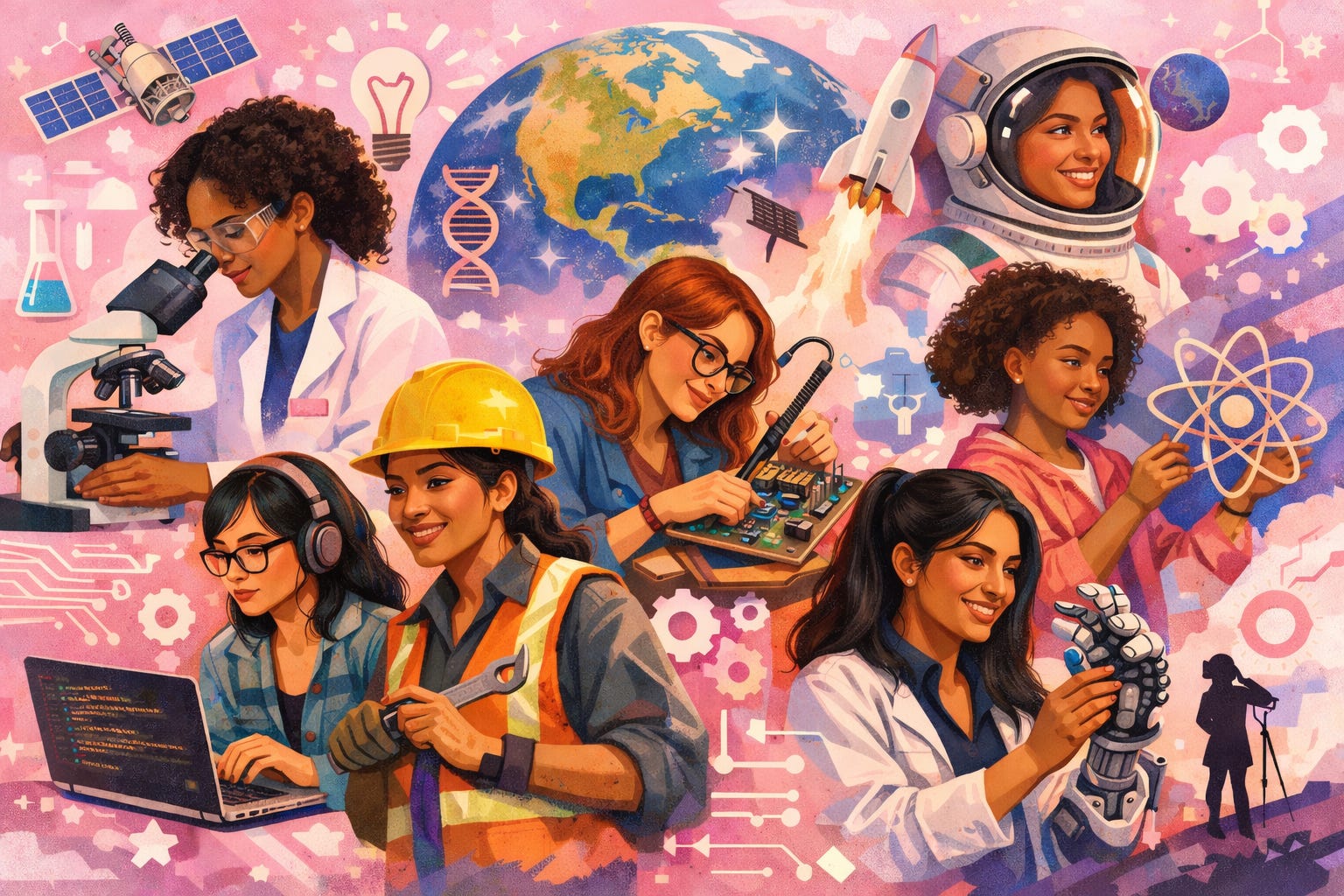
Today is International Women’s Day and also part of global observances that celebrate women and girls in science, technology, engineering, and mathematics. On this day, the world is invited not just to applaud progress, but to pause and re-commit to a future where gender is not a barrier to participation, influence, or impact.
I have been watching the global conversations unfold from UNESCO shining a spotlight on women and girls in science to the The Nobel Prize organization, honouring the legacy of Marie Skłodowska Curie, and the rest of them, and I’m moved by how these stories remind us of both progress and the work that still lies ahead.
In many ways, this day asks a question that designers ask each time we build a product:
Who is this for? And have we made space for her voice, her experience, her perspective?
Why This Day Matters Globally
Since 2015, the United Nations has recognized 11 February as the International Day of Women and Girls in Science — a day dedicated not only to celebration, but to addressing long-standing gender gaps in STEM fields.
The data makes the case clear:
Women represent roughly one in three researchers worldwide — and in many countries, that number is much lower.
Women make up only about 35% of STEM graduates globally.
In cutting-edge fields such as AI, only about 22% of professionals are women, and the number shrinks further at leadership levels.
Historical achievements like Marie Curie’s Nobel Prizes are remarkable not only for their brilliance, but for how rare such recognition has been for women across science.
These numbers are not just statistics. They are stories — stories of exclusion, perseverance, and untapped potential.
Beyond Participation: Representation and Leadership
It is one thing to have women in science. It is another thing entirely to have women leading science, technology, and innovation.
Despite gains in higher education enrollment globally, true representation still lags:
Women are significantly under-represented in senior research positions in most scientific fields.
Leadership tables from academic departments to corporate tech boards remain disproportionately male.
And when women do reach leadership, their journeys often include navigating bias, rigid cultural expectations, and systemic barriers that shape every step of their careers.
This mirrors the narratives shared by many women on LinkedIn today, noting that the problem is not talent, but opportunity and support.
A key takeaway - Representation is not a finish line, it’s a process that includes:
Building inclusive pathways
Redesigning institutions
Rethinking mentorship and sponsorship
Addressing cultural and structural bias
What This Means for Technology and UX
As someone who works at the intersection of design, technology, and human experience, today’s themes resonate deeply.
Technology is not neutral.
Every interface, every algorithm, every dataset and model reflects assumptions often unconsciously built into them by the people who create them.
When women are under-represented in innovation spaces:
Products miss essential perspectives
AI systems are trained on incomplete worldviews
Decision-making excludes half of humanity
In AI research, for example, gender imbalances in data can lead to models that provide skewed outcomes from biased voice recognition to unequal healthcare predictions. Diverse teams mitigate bias because they ask questions others hadn’t thought to ask. Diversity is not a luxury; it is a core component of trustworthy tech.
Amplifying Voices, Not Just Counting Numbers
Today’s Nobel Prize post celebrating Marie Skłodowska Curie illuminates not only her achievements but why recognition matters. In her era, she defied gender norms to produce science that fundamentally changed our understanding of physics and chemistry. The fact that her story still resonates today speaks to how far we’ve come and how far we must go.
We must also honor current and emerging voices - women whose research, coding, experimentation, and leadership are pushing boundaries even while they face structural headwinds.
This is not just representation for optics, this is representation for progress.
Why Inclusion Matters for Design and AI
When we talk about UX or AI, we are really talking about experience of how humans interact with systems, tools, and each other.
Designing for everyone means:
Seeing the lived experiences of women and girls as essential input
Recognizing that inclusion leads to more robust solutions
Realizing that products that work for diverse populations are better for all
When we fail to include half of humanity, the technologies we build will reflect that absence in blind spots, in assumptions, and in missed opportunities.
This is why gender inclusion is not only a matter of fairness but a matter of quality, relevance, and impact in technology and innovation.
Celebrating Progress and Renewing Commitment
International Women’s Day and International Day of Women and Girls in Science are not merely celebratory dates on a calendar. They are calls to action.
They remind us that:
Equity matters at every stage, from classrooms to leadership
Progress requires intentional design
Technology must be built with humanness at its center
So today, I want to say:
Thank you to every woman who persisted in science, in design, in research, in leadership, in family responsibilities, in community support — thank you for showing us what resilience looks like.
Thank you to every girl who dreams of coding, experimenting, inventing, and leading. Your place in science is not conditional, it is necessary.
And thank you to every person, regardless of identity, who allies, advocates, designs intentionally, and opens doors.
Together, we do not just change numbers. We change narratives.
We change systems. We change futures.
#BlessingSeries #Technology #InternationalWomensDay #WomenInSTEM #STEM #WomenInScience #GenderEquality #HumanCenteredDesign #AIWithPurpose #UXDesign #InclusiveInnovation #EveryVoiceInScience #DesignForAll