
🔮 #BlessingSeries Issue 52 — "Design Is Dead." I Keep Hearing That, But I Simply Do Not Believe It.
Artificial Intelligence is not replacing designers. It is challenging us to solve problems we have never had to solve before.

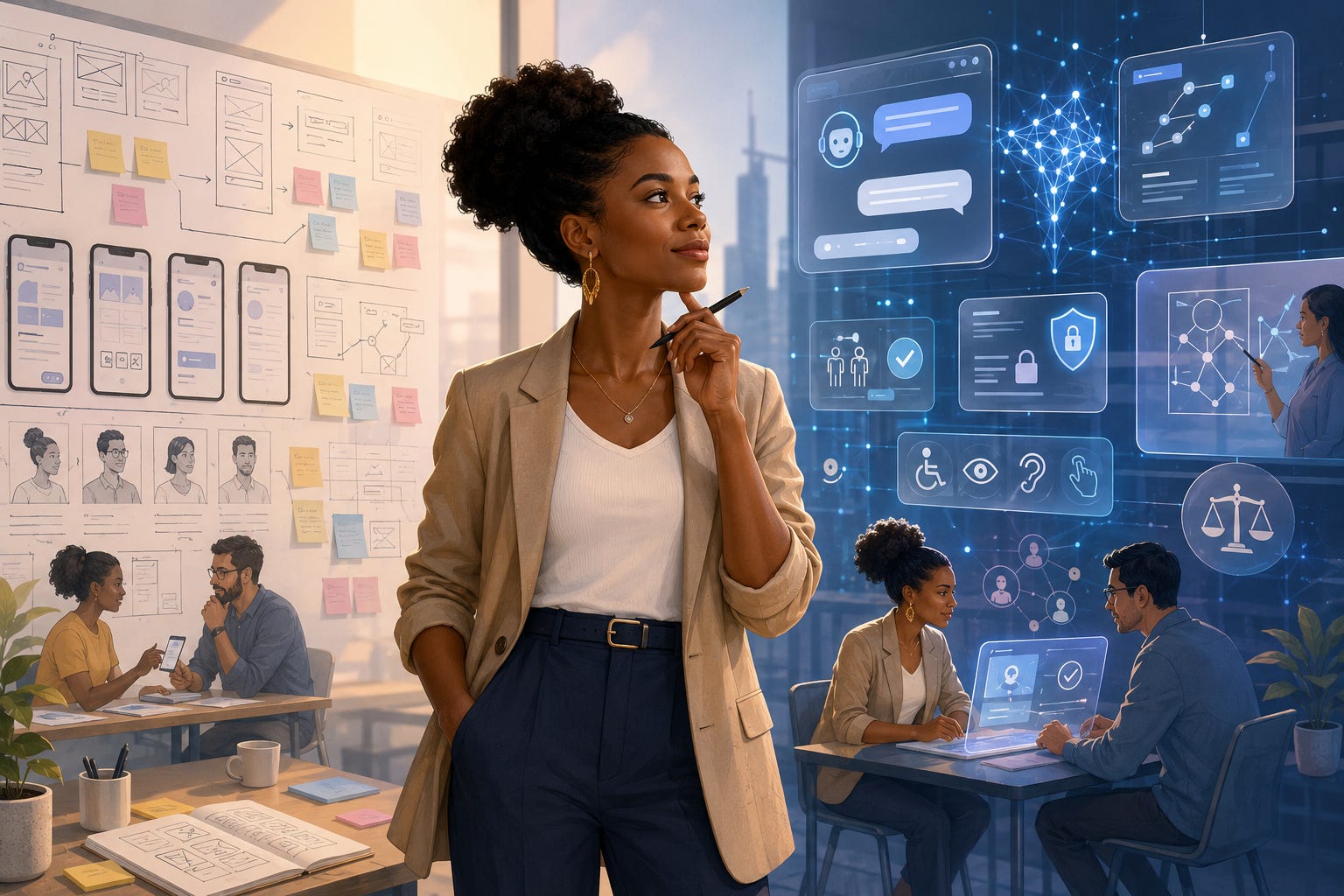
“Design is dead.” I’ve lost count of how many times I’ve read those three words in recent times. Over the past one or two years, I have seen countless posts claiming that design is dead because Artificial Intelligence can now generate interfaces, write code, and even create prototypes in minutes. Every time a new AI model is released, someone declares that designers are no longer needed.
I would normally pause and laugh anytime I come across those headlines.....😁
Not because I disagree that AI is changing our profession. It absolutely is. Not because the conversation isn’t important. It absolutely is. I smile because I have heard similar predictions before. Years ago, people thought websites would eliminate graphic designers.
Then mobile apps arrived.
Then design systems.
Then no-code platforms.
I smile because I think we are asking the wrong question. The real question is not whether design is disappearing. The real question is what designers are being asked to design now.
A few days ago, I was watching my child put together a simple puzzle. He was convinced a particular piece belonged in one spot. He tried again and again, but it simply would not fit. Instead of giving up, he stopped, looked at it from another angle, rotated the piece, and tried again. A few seconds later, he smiled because he had discovered that the piece belonged somewhere completely different.
Watching him reminded me of where our profession is today.
The puzzle has changed, but that does not mean the puzzle no longer needs solving.
It simply means we need to approach it differently.
For many years, UX designers spent much of their time thinking about navigation, layouts, colours, typography, and user flows. Those things still matter, but they are no longer the only challenges in front of us.
Today, I spend just as much time thinking about questions like these:
Can people trust the recommendations made by an AI system?
How should an AI explain why it reached a particular decision?
What should happen when the AI makes a mistake?
How do we make sure someone always feels in control instead of feeling controlled by technology?
How do we build systems that work fairly for people from different cultures, languages, abilities, and backgrounds?
These are not visual design problems.nThey are human problems. And human problems have always been the heart of UX design.
Artificial Intelligence is remarkably good at generating outputs. It can produce screens, suggest layouts, summarize research, write code, and automate repetitive work faster than many of us imagined only a few years ago.
But technology alone cannot decide what people should trust.
It cannot determine whether an experience feels respectful.
It cannot recognise when a recommendation unintentionally excludes someone.
It cannot replace empathy.
It cannot replace ethical judgement.
It cannot replace the curiosity that leads us to ask, “Why are people struggling here?”
Those responsibilities still belong to us.
That is why I find all the conversations about AI replacing designers both fascinating and incomplete.
The profession is not shrinking. Instead, it is expanding into areas many of us were never formally taught. Today, we are designing conversations between humans and machines. We are designing confidence without creating false certainty. We are designing transparency so people understand what AI is doing. We are designing safeguards that protect privacy, reduce bias, and keep humans involved when important decisions are being made.
In many ways, our work has become more challenging than ever before. And honestly, I think that is exciting.
The best designers have never been defined by the tools they use. They have always been defined by the problems they solve.
Artificial Intelligence has given us a new set of problems to solve, and they are some of the most meaningful our profession has ever faced.
So, when someone says, “Design is dead,” I cannot help but think they are looking at only one small piece of the puzzle. From where I stand, design is very much alive.
It is simply growing into something bigger than many of us imagined.
Perhaps the future does not belong to designers who compete with AI. Perhaps it belongs to designers who understand how to design with AI, while never losing sight of the people on the other side of the screen.
#BlessingSeries #ArtificialIntelligence #UXDesign #UserExperience #HumanCenteredDesign #DesignThinking #ResponsibleAI #AIUX #ProductDesign #Innovation #FutureOfDesign #HumanCenteredAI #AIEthics #Accessibility #Technology